

Every scooper design solves the bending. Only one solves the washing. A no-touch pooper scooper mounts the disposable bag so that the bag itself becomes the scooping surface — which means the tool never contacts anything, and there is nothing to rinse off in the garden when you get home.
How the bag-mounted design actually works
A conventional scooper is a jaw or a tray. It picks the mess up, you tip it into a bag, and now you own a dirty jaw. Manufacturers suggest hosing it down. In practice it lives in the garage and everybody resents it.
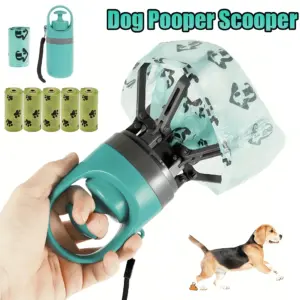
The bag-mounted version inverts that. The bag clips over the mouth of the scoop and lines it. You squeeze the handle, the mouth closes with the bag between it and the ground, and the waste ends up inside the bag without touching the tool at any point. Release, tie, bin. Nothing to clean.
The long handle does the same job it always did — you stay upright — but the meaningful change is that the maintenance is gone, and a tool with no maintenance is a tool that gets used.
Where it outperforms a rigid scoop
The bag conforms to the ground. That sounds like a small thing and it is the whole advantage on two surfaces that defeat rigid jaws.
- Wet or soft messes, where a rigid tray smears rather than lifts.
- Long grass, where a jaw closes on grass and misses what is underneath.
- Gravel and bark chip, where a tray scoops up half the path with it.
- Cold mornings, when a rigid plastic jaw is at its most brittle.
On a hard flat surface — a patio, a pavement — a rigid jaw is perfectly adequate and often faster. The bag design earns its place everywhere else.
What defeats it
Wind, mostly. An unclipped or loosely clipped bag will invert on a gusty day, which is a fixable annoyance if you check the clip and an unfixable one if the clip mechanism is flimsy. That is the single component worth examining before buying.
The other limit is volume. These are sized for a walk, not for a weekly clear of a garden a large dog has had to itself. For that job you want a rake and a bin, and no clever mechanism will change it.
Where the full bag goes for the rest of the walk
This is the unglamorous half of the problem and the reason a lot of scoopers get abandoned. You are now twenty minutes from home holding a tied bag, and the tool you are carrying was designed to hold a clean one.
Models with a carabiner or a clip on the shaft solve it by letting the tied bag hang off the handle, away from you. Models without leave you carrying it, which works but is exactly the experience you were trying to avoid. If a design detail is worth paying a couple of dollars more for, it is this one.
The other half is bin availability, which is a route problem rather than a product one. It is worth knowing where the bins are on your usual walk before you decide the scooper is the thing at fault.
Bag compatibility is the buying decision
Some scoopers take any standard bag; others are built around a proprietary size, and that is a running cost you inherit for the life of the tool. Check before buying, because the difference over a few years is considerably more than the price of the scooper.
Standard bags also mean you can use compostable ones where your municipality accepts them, which a proprietary system may not offer at all.
Where it lives between walks
A scooper is an awkward object: long, not quite clean by association, and too useful to put in the shed where you will forget it. Most people end up leaving it by the door, which works until it falls over.
A model with a hanging hole in the handle solves this for the price of a hook, and it is worth checking for. Standing a long-handled tool in a corner is how it ends up on the floor every time somebody opens the door.
The related point is loading it before you leave. A scooper with a fresh bag already clipped in is a tool you use; one that needs a bag fitted while a dog is pulling towards the park is a tool you leave at home and go back to using a bag over your hand. Keep the roll with the scooper rather than in a kitchen drawer, and the habit survives.
Shop this guide
Picks from this category, priced in USD.
-
Pet accessories
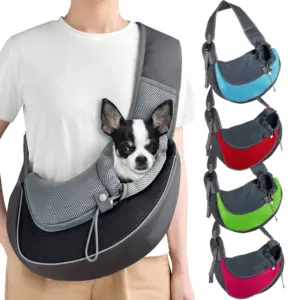
Crossbody Pet Sling Carrier – Hands-Free Travel Tote for Small
Price range: $19.99 through $24.99 Select options This product has multiple variants. The options may be chosen on the product page -
Pet accessories
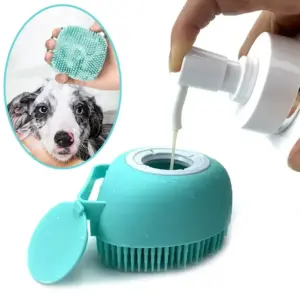
Silicone Pet Grooming Glove – Bath Brush and De-Shedding
$7.99 Select options This product has multiple variants. The options may be chosen on the product page -
Pet accessories
Dog Pooper Scooper with Built-In Bag Dispenser – One-Handed
Price range: $9.99 through $25.99 Select options This product has multiple variants. The options may be chosen on the product page
Frequently asked questions
Does it work one-handed while holding a lead?
Yes, and that is most of the point. The squeeze mechanism is designed for one hand. The part that needs two hands is loading a fresh bag, which is worth doing before you leave the house rather than in a park with a dog winding a lead round your legs.
Can you use it for cat litter?
It is the wrong shape. Litter scoops are slotted so the clean litter falls through; a bag-lined scoop keeps everything. Different job, different tool.
How long does the handle need to be?
Long enough that you are not stooping, which for most adults means the mouth sits at the ground with your back straight. Too long is a real thing though — an over-long handle is awkward to aim and worse to store.
More of the same in pet gadgets that make pet life easier and the pet gadgets collection. For the walk itself, carry-on travel gadgets covers what is worth carrying.