

Your arm gives out long before the dog does. An automatic ball launcher indoors is the obvious answer to that, and it does work in a flat — but the specification that matters inside is almost the opposite of the one that matters in a park. Distance, noise and what your floor is made of decide whether it becomes a daily habit or a cupboard ornament.
Launch distance: the number to look at first
Outdoor launchers throw 30 feet and up. Indoors, that is a machine firing a ball into a wall at speed, and the dog learns to intercept early rather than chase, which defeats the point.
What you want inside is an adjustable low setting in the region of 10 feet, which is enough to make a dog move across a room without the ball becoming a projectile. Compact launchers built for the purpose sit on a table and run roughly 10 to 20 feet at the low end. A launcher with no low setting is an outdoor machine regardless of how it is marketed.
The safety feature worth insisting on
A dog that is enjoying itself will put its face directly over the launch tube. Every dog does it. The feature that matters is a sensor that halts the launch when something is detected near the opening, sometimes combined with a physical arc over the tube.
This is not an optional extra on a machine that fires at head height on a table. If a listing does not mention detection or a guard, assume there is not one.
Noise, and why it decides the whole thing
The spin-up whine before each launch is the part nobody anticipates. Outdoors it disappears. In a living room it is a repeated mechanical noise at close range, and a meaningful number of dogs are unsettled by it — some refuse to approach the machine at all, which is an expensive way to discover a preference.
It matters for you as well. A launcher running while you work is a noise every twenty seconds, and quiet operation is a genuine differentiator rather than a marketing line.
Floors, and the injury nobody plans for
This is the indoor-specific risk. A dog sprinting after a ball on laminate, tile or polished wood cannot turn, and the stop at the end is a skid into a wall or a twist through the hips. Repeated hard turns on a slick floor are how soft-tissue injuries happen, and a launcher is a machine for generating exactly that repetition.
- Put a runner or a rug along the line of fire, so there is grip where the dog accelerates and stops.
- Aim it down the longest clear line in the room, away from furniture corners and glass.
- Set a session limit. A launcher will outlast any dog, and a dog chasing on adrenaline will not stop when it should.
- Take it away between sessions if you have a dog that would otherwise stand over it all evening.
Which dogs it does not suit
Obsessive ball dogs, mainly. For a dog already fixated, a machine that dispenses fetch on demand can deepen the fixation rather than tire it out, and you end up with an animal that cannot settle. The dogs it suits best are the ones with plenty of drive and an owner with a sore shoulder.
Very small dogs are a size problem rather than a temperament one — standard tennis balls are too large for some mouths, and most launchers will only take the size they were built for.
Mains power, batteries, and where it lives
Most launchers run on either mains power or batteries, and indoors the answer is almost always mains. Battery models are built for a park, where there is no socket; in a living room the battery is a consumable you are buying repeatedly for no benefit. A model that takes both is the useful compromise, because it means the machine still works on a lawn without you buying a second one.
The other consideration is where it lives between sessions, which sounds trivial and decides whether the thing gets used. A launcher that has to be dug out of a cupboard and set up gets used twice. A launcher that sits in the corner of the room, plugged in, gets used daily. If it is too large or too ugly to leave out, be honest about that before buying rather than after.
Footprint is the number to check against the room. A compact table-top unit is genuinely small; the mid-range models are closer to the size of a small bin and do not disappear into a flat.
Shop this guide
Picks from this category, priced in USD.
-
Pet accessories
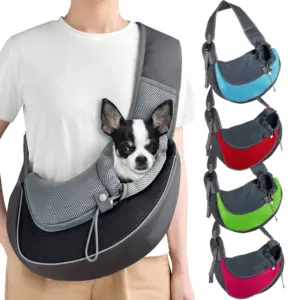
Crossbody Pet Sling Carrier – Hands-Free Travel Tote for Small
Price range: $19.99 through $24.99 Select options This product has multiple variants. The options may be chosen on the product page -
Pet accessories
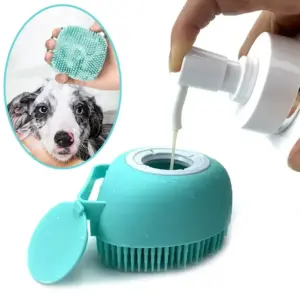
Silicone Pet Grooming Glove – Bath Brush and De-Shedding
$7.99 Select options This product has multiple variants. The options may be chosen on the product page -
Pet accessories
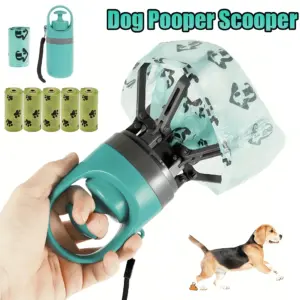
Dog Pooper Scooper with Built-In Bag Dispenser – One-Handed
Price range: $9.99 through $25.99 Select options This product has multiple variants. The options may be chosen on the product page
Frequently asked questions
Can a dog learn to load it themselves?
Many do, and it is the feature that makes a launcher genuinely hands-free. It takes teaching — usually rewarding the drop over the hopper in stages — and some dogs never take to it. Do not buy on the assumption that yours will.
Does it replace a walk?
No. It replaces the throwing arm, not the walk. Fetch is exercise but it is not the sniffing, the varied ground or the outside world, and a dog that gets only fetch is under-stimulated in ways that show up as behaviour.
Will it work with the ball my dog already has?
Usually only if it is a standard size and reasonably firm. Soggy, chewed or undersized balls jam the mechanism, which is the most common complaint about every model.
More in pet gadgets that make pet life easier and the pet gadgets collection. If you are buying it as a present, see practical gadget gifts under $50.