

Both crush garlic without your fingers smelling of it for two days. The difference is not quality, it is texture and washing up, and those two things point at different cooks. Here is the honest garlic twist vs garlic press comparison, including the case for owning neither.
The mechanism, and what it does to the garlic
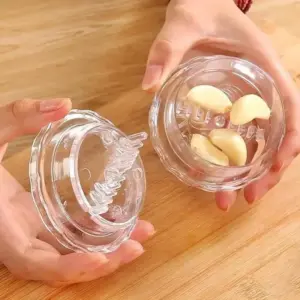
A press is a hinged lever. You put a clove in a perforated chamber and squeeze; the garlic extrudes through small holes as a fine, wet paste. A twist is a two-part chamber with interlocking plastic teeth. You drop cloves in, twist the halves against each other, and the garlic is chopped between the teeth rather than forced through a grid.
So the press gives you paste and the twist gives you a coarse mince, and neither is better in the abstract. Paste dissolves into a dressing or a marinade and disappears into a sauce. A coarse mince holds its shape in a stir fry and browns rather than burning, which is the failure mode of pressed garlic hitting a hot pan.
Cleaning: the difference people actually notice
This is where the twist wins clearly. The chamber is large, open and smooth plastic, so a rinse under the tap clears it. There is no grid to work at.
A press has small holes, and garlic lodges in them. Usually a rinse or a brush clears it, and many presses ship with a little plastic comb for exactly this reason — the existence of the comb tells you how common the problem is. Leave a press in the sink for an hour and the residue dries into the holes, at which point it is a genuine chore.
The counter-argument is worth stating: some twist designs jam garlic between the threads where the two halves meet, which is its own version of the same problem. A wide-chamber design with coarse teeth avoids it; a narrow one does not.
Which one suits how you cook
- You make dressings, aioli, marinades and anything where garlic should vanish — press.
- You cook stir fries, curries and pasta where garlic should be visible and browned — twist.
- You cook garlic-heavy food several times a week and resent washing up — twist.
- You want a single clove done in three seconds with no thought — press.
- You have limited hand strength — twist, generally. A rotating action uses larger muscles than a squeeze, though a long-handled press is a reasonable alternative.
Quantity is the tiebreaker nobody mentions
A press takes one clove at a time. That is fine for a clove or two and tedious at six, which is roughly the point at which most people give up and reach for a knife anyway.
A twist takes a small handful at once, which makes it the better tool for the way people actually cook garlic-heavy food — a whole bulb going into a batch of sauce, not a single clove going into an omelette. If your cooking runs to quantity, that difference matters more than texture does.
There is a related durability point. A press is doing hard work on a small hinge every time, and a cheap one develops play in that hinge within a year. A twist has no hinge to wear; its failure mode is teeth rounding off, which takes considerably longer.
The case for neither
A knife does both jobs, costs nothing extra and washes in the same motion as everything else. Serious cooks tend to say so, and they are not wrong. Where the gadgets earn their place is speed under pressure and the smell on your fingers, and if neither of those bothers you, the drawer space is better spent elsewhere.
The one genuine advantage a press has over a knife is that it needs no board, which matters more in a small kitchen than it sounds.
Storage, smell and the plastic question
Both tools hold onto garlic smell, and neither dishwasher nor detergent removes it entirely from plastic. The practical mitigation is to wash immediately rather than later — garlic residue that has dried is what embeds the smell — and to store the tool with the chamber open so it dries fully.
Stainless presses are less absorbent and hold less odour over years, which is the strongest argument for paying more for one. Plastic twists will pick up a faint permanent smell and it does not transfer to food, but people notice it in a drawer.
Discolouration is normal on both and is not a hygiene problem: garlic contains sulphur compounds that stain, particularly on lighter plastics. A stained chamber that rinses clean is fine. A chamber with garlic visibly packed into a corner that will not shift is the one to deal with, because that is where a smell becomes a genuine problem.
Shop this guide
Picks from this category, priced in USD.
-
Kitchen gadgets
Silicone Ice Cube Cup – Squeeze-Release Mould That Drops Cubes
$9.99 Select options This product has multiple variants. The options may be chosen on the product page -
Kitchen gadgets
Garlic Twist Crusher – Mince Cloves Without a Board or Knife
$4.99 Select options This product has multiple variants. The options may be chosen on the product page -
Kitchen gadgets
4-in-1 Jar Opener – Twist Off Stiff Lids, Caps and Bottles
$9.99 Select options This product has multiple variants. The options may be chosen on the product page

Frequently asked questions
Do you have to peel the clove first?
For a twist, yes. For most presses, no — the skin stays behind in the chamber and you pull it out afterwards, which is one of the press’s better arguments.
Does crushed garlic taste different from chopped?
Yes, noticeably. Crushing ruptures more cells and releases more allicin, so pressed garlic is sharper and more pungent than the same clove chopped. If a recipe tastes harsher than you expected, the press is a likely culprit.
Are plastic ones durable enough?
The teeth are the wear point. Good ones use a hard, thick plastic and last for years; thin ones round off and start slipping. It is the part to look at in the photos.
More of the same thinking in small kitchen gadgets worth buying and the kitchen gadgets collection. Our standard for stocking anything is in how we choose products.