

You stuck them on, they held for a fortnight, and now there is a clip on the floor and a charging cable back behind the desk. Adhesive cable clips have a reputation for not lasting, and it is half deserved — but the failure is usually the surface, the prep or the placement, and all three are fixable in about five minutes.
Reason one: the surface was clean, but not clean enough
A desk that looks clean carries a film of skin oil, furniture polish and dust that adhesive cannot bond through. Wiping with a damp cloth moves it around. Wiping with a household spray adds a silicone residue that is actively worse.
What works is isopropyl alcohol on a lint-free cloth, then a full minute of drying before the clip goes on. That single step is the difference between a clip that lasts a week and one that lasts years, and it is the step nearly everyone skips.
Reason two: it was loaded before the bond cured
Pressure-sensitive adhesive does not reach full strength on contact. It needs firm pressure for thirty seconds to wet out against the surface, and then it keeps building strength for hours — most manufacturers quote something in the region of 24 hours to full bond.
Threading a heavy cable through a clip you stuck on ten minutes ago puts a peeling load on an adhesive at a fraction of its eventual strength. Stick them all, then go and do something else, then thread the cables tomorrow.
Reason three: the surface will never work
Some materials do not take adhesive, and no amount of prep changes that. The common ones under a desk are the disappointing ones.
- Raw or oiled wood — the oil keeps migrating to the surface and the bond releases.
- Textured or powder-coated metal — the adhesive only touches the high points of the texture.
- Silicone, or anything that has been polished with a silicone-based product.
- Dusty painted plasterboard, where the paint itself lets go before the glue does.
- Anything below roughly 10°C when you apply it. Cold adhesive never wets out properly, and a cold garage desk in January is a guaranteed failure.
For those, a clip with a screw fixing or a weighted cable holder that simply sits on the desk is the honest answer.
The cable you unplug every day is a different problem
There is a distinction worth drawing between cables that live where you put them and cables you handle daily. A monitor lead gets routed once and never moves. A phone charger gets tugged, coiled, dropped and pulled at an angle a hundred times a month.
A clip that grips hard enough to hold a permanent cable is annoying on a daily one, and a clip loose enough to be pleasant on a daily cable will not retain a heavy one. Using the same clip for both is the most common reason people conclude the whole category does not work.
For the daily cable, what you want is a holder the cable drops into rather than threads through, positioned at the desk edge where your hand naturally lands. For the permanent runs, a tighter clip underneath, out of sight, where it can be as stiff as it likes.
Placement: pull direction matters more than clip count
Adhesive is strong in shear, where the load runs parallel to the surface, and weak in peel, where the load lifts one edge. A clip on a vertical desk leg with a cable hanging straight down is loaded in shear and will hold far more than the same clip on the underside of a desk with the cable pulling away from it.
So the fix for a heavy cable is rarely more clips. It is one clip positioned so the cable pulls along the surface rather than away from it, with a second clip further along to take the direction change.
How many you actually need
People buy a pack of twenty and use six. The useful count is decided by the corners, not the cables: a cable run needs a clip where it changes direction and a clip near each end, and almost nothing in between.
A straight run of half a metre across a flat desk back does not need a clip in the middle. It is already going where it should. Adding one there is a fixing you will have to remove later when the layout changes, and every unnecessary clip is another mark on the desk.
The exception is weight. A heavy cable hanging vertically wants intermediate support, because the load at the top clip is the whole cable and that is a peeling load. Two clips a hand-span apart share it much better than one at the top.
Shop this guide
Picks from this category, priced in USD.
-
Desk setup gadgets
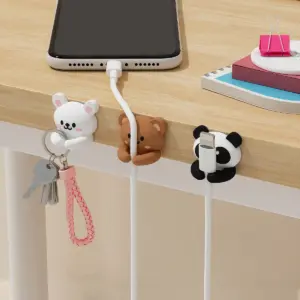
Cute Animal Cable Clips – Adhesive Bear, Panda and Rabbit Cord Holders
Price range: $7.99 through $14.99 Select options This product has multiple variants. The options may be chosen on the product page
Frequently asked questions
Will they damage the desk when removed?
On a sealed or laminated surface, generally no — warm the adhesive with a hairdryer and pull slowly parallel to the surface rather than straight out. On veneer, unsealed wood or paint, there is a real risk of lifting the finish, and that risk is the reason to think before sticking one to something you care about.
Can I reuse a clip after taking it off?
The clip yes, the adhesive no. Once a pad has been peeled it has picked up dust and will not bond again. Replacement adhesive squares are cheap and are the fix.
How many cables can one clip hold?
Fewer than you want it to. A clip sized for one cable that is holding three is loaded across a wider span and peels from the edges. Two clips with two cables each outlast one clip with four, every time.
The rest of the desk problem is covered in desk setup gadgets for a tidier workspace, and the range is in the desk setup collection. If the cables in question are in a car rather than under a desk, see car accessories that fix commute annoyances.