

Every hallway has the same pile by the door, and every solution to it is sold on how many pairs it holds. In a narrow entryway that is the wrong number to shop on. Shoe storage for a narrow entryway is a depth problem first, a width problem second, and a capacity problem a distant third.
Measure the depth you can actually give up
A hallway needs a clear walking width, and the moment a rack eats into it you have traded a shoe pile for a shin-barking obstacle that everyone resents. Before looking at any product, measure the hallway width and subtract the clear path you need — a comfortable single-file corridor is around 30 inches, less if it is short and you are willing to turn sideways.
What is left is your depth budget, and it is usually smaller than people expect. A standard shoe rack is around 12 inches deep, which is more than many hallways can spare. If your budget comes out under 10 inches, you are looking at angled or vertical storage rather than a conventional rack.
Width is rarely a round number
Entryway gaps are the leftovers between a door frame, a radiator and the stairs, so they come in awkward widths that no fixed-size furniture matches. You either accept a rack that leaves four inches of dead space at one end, or you find something that adjusts.
This is the specific case that expandable racks solve. A rack that telescopes between two widths covers a range rather than a single dimension, which means it fits the gap you have rather than the gap a manufacturer imagined. It is also the thing that survives a move, which a made-to-measure solution does not.
Under-shelf and stacking: the vertical answer
When floor depth is genuinely unavailable, the space to use is above. An under-shelf rack hangs beneath an existing shelf and turns dead air into a row of shoes without touching the floor at all. In a hallway with a coat shelf already installed, it is the highest-value change available.
Stacking is the other vertical route, and the caution is stability: a tall narrow rack in a corridor gets knocked, and a two-tier rack that is not braced or wall-fixed will eventually go over. If it is taller than it is wide, it wants a fixing.
The hooks nobody counts as shoe storage
A surprising amount of a hallway pile is not shoes at all. It is the bag that gets dropped on top of them, the lead, the umbrella and whatever came home from school. Clear those onto hooks and a rack that was overflowing turns out to have been adequate.
Hooks are also the cheapest depth in the house: a hook projects three or four inches and holds something that would otherwise take a square foot of floor. In a corridor too narrow for any rack at all, a rail of hooks plus a single shallow tray for wet shoes is often the entire workable solution.
The one rule is height. Hooks at adult height in a narrow hallway are what you walk into with a shoulder; set them above head height for the things you rarely need and at child height for the coats that get used daily.
What to store there, and what not to
- Keep only the current season by the door. A hallway rack holding every pair anyone owns is a rack that overflows within a week.
- Boots defeat most racks. Give them floor space beside the rack rather than trying to make them fit into it.
- Wet shoes want a tray, not a shelf, or the water goes into whatever is below.
- Leave the bottom row empty if you can. It is where the vacuum needs to go.
The rule that keeps a hallway working is one in, one out: when the rack is full, something goes back to a bedroom. Storage does not create capacity, it just organises the capacity you already decided on.
Wet season, and the tray that saves the floor
Every hallway system that works in July fails in November, because wet and salted boots arrive and there is nowhere for the water to go. Planning for that from the start is the difference between a hallway that works all year and one that is abandoned by December.
A boot tray with a raised lip is the single most useful addition, and it wants to be positioned where people actually stop — immediately inside the door, not tucked beside the rack where nobody will walk to. Salt stains on a hallway floor are much harder to remove than they are to prevent.
The second measure is airflow. Wet shoes stored in a closed cabinet do not dry, and a closed cabinet full of damp boots develops a smell that outlasts the winter. Open racks beat enclosed units in any hallway that sees real weather, whatever the enclosed one looks like.
Shop this guide
Picks from this category, priced in USD.
-
Home organization gadgets
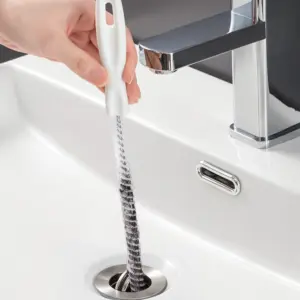
Drain Cleaning Utensil – Flexible Clog Remover
Price range: $3.49 through $3.99 Select options This product has multiple variants. The options may be chosen on the product page -
Home organization gadgets
Motion Sensor Bathroom Trash Can – Slim 13.8 cm Hands-Free Bin
Price range: $69.99 through $74.99 Select options This product has multiple variants. The options may be chosen on the product page -
Home organization gadgets
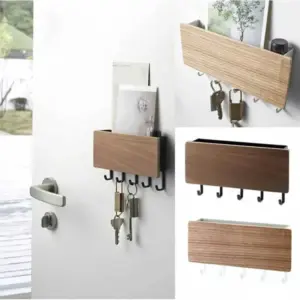
Wall Key Holder with Shelf – 5 Hooks and an Entryway Tray
Price range: $12.99 through $14.99 Select options This product has multiple variants. The options may be chosen on the product page

Frequently asked questions
How deep does a shoe rack need to be?
Around 10 to 12 inches for adult shoes stored straight on. Angled racks, which tip the shoe nose-up, work in as little as 7 or 8 inches, at the cost of holding fewer pairs per row.
Is an expandable rack sturdy enough?
The good ones are, and the weak point is always the telescoping joint rather than the shelves. Check that it locks positively rather than relying on friction, and set it at the width you need rather than at full extension where the overlap is smallest.
What about a bench with storage underneath?
Excellent if you have the depth, because it solves sitting down to put shoes on as well. Most narrow hallways do not, and a bench that blocks the corridor is worse than a pile of shoes.
More of the same in home organization gadgets that actually work and the home organization collection. For the desk equivalent, see desk setup gadgets for a tidier workspace.