

Low winter sun, a wet morning, the defroster on full, and suddenly the windshield is a grey smear you can barely see through. Most of that isn’t on the outside, where the wipers work. It’s on the inside, where nothing does. Learning to clean the inside of a windshield properly takes about five minutes, and the trick has less to do with what you clean it with than with how little of it you use.
Where the film comes from
The inside of a car is a closed box that heats up and cools down every day. Vinyl and plastic trim give off a faint oily residue as they warm, and it settles on the coldest surface in the car, which is the glass. Car makers test interior materials for exactly this, and call it fogging. Add breath, fingerprints from adjusting the mirror, and whatever the heater blows off the dash, and you have a thin film that is invisible most of the time.
You see it in two situations: when the sun is low in front of you and every smear lights up, and when the glass fogs, because moisture clings more readily to a film than to clean glass. At night it does a third thing, scattering the glare of oncoming headlights across the whole windshield.
Why the inside streaks when the outside doesn’t
On the outside you can flood the glass with water and a squeegee, and the wipers finish the job. On the inside you can’t. There’s a dashboard under the glass, the angle is steep, and the bottom corner is buried behind the steering wheel. So people reach for a spray and a paper towel, and the result is a smeared film that looks worse in the sun than it did before.
Streaks come from three things, and the cloth is only one of them.
- Too much liquid. A soaked cloth pushes dissolved grime around instead of lifting it, and leaves it behind as it dries.
- A dirty cloth. A cloth that has already lifted the film is now spreading it. Fold it to a clean face, or change it.
- Residue in the cleaner or the cloth. Scented household sprays, and microfibre washed with fabric softener, leave a film of their own.
The two-cloth method
What works is a wet pass and a dry pass, with a clean cloth for each.
- Spray the cloth, not the glass. Spraying the windshield sends overspray onto the dash, and the dash is where the film came from in the first place.
- Wipe with the damp cloth in overlapping strokes, side to side across the whole windshield, then top to bottom. Two directions make it easy to tell which pass left a streak.
- Follow straight away with a dry cloth, before the glass dries on its own, and buff until it squeaks.
- Do the edges last, where the glass meets the trim, because that is where the film is thickest and where a cloth tends to stop short.
Plain water does a surprising amount of the job on a lightly filmed windshield. A glass cleaner helps on a heavy film, and if your side windows carry an aftermarket tint film, use a cleaner labelled safe for tinted windows.
Reaching the corner by the dash
The bottom of the windshield is the hard part. It meets the dash at a shallow angle, it’s behind the steering wheel on the driver’s side, and the passenger side is a long lean across the seat. That is where most people give up, and it’s exactly where the low sun lands.
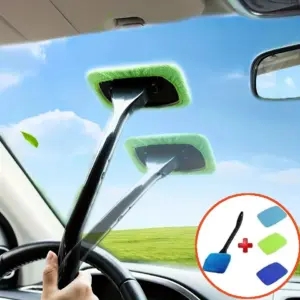
A long-handled windshield tool solves it: a flat pad covered in microfibre on the end of a handle, so the pad sits flat on the glass down by the dash while your hand stays somewhere comfortable. Look for three things.
- A head that pivots, so the pad stays flat against the glass all the way down to the dash.
- A cover that comes off for washing, and ideally a spare, so the wet and the dry pass each get a clean one.
- A head small enough to get into the corners, on a handle long enough to reach the passenger side from the driver’s seat.
On a large SUV or van windshield, expect more passes with a small head, and check whether the handle extends if the dash is very deep.
Keeping the covers and cloths clean
Microfibre works because its fibres trap grime and oil instead of pushing them around, which also means a dirty cover is a film-spreading tool. Wash the covers and cloths on their own, without fabric softener, and let them air-dry. Keep one clean, dry cover in the glovebox for the morning the sun catches the smear on the way to work.
Cold weather, and the fog that follows
Winter is when the inside of the glass is at its worst, and also the hardest time to clean it, because cleaner on a freezing windshield smears and can freeze. Do it with the car warmed up and the glass at cabin temperature, or on a milder afternoon.
For the fog itself, the fixes are about the air rather than the glass. Run the defroster with the air conditioning on, which dries the air it blows onto the windshield. Switch from recirculated air to fresh air, so the damp air in the cabin gets replaced. And knock the snow off your boots before you get in, because slush on the floor mats is moisture headed for the glass; the moulded rubber trays in our guide to car accessories that fix everyday commute annoyances make that last one easier.
Shop this guide
The one this guide is about, and more from this category, priced in USD.
-
Car accessories
Windshield Cleaning Tool – Long-Handle Microfiber Car Window Cleaner
Price range: $17.99 through $23.99 Select options This product has multiple variants. The options may be chosen on the product page -
Car accessories
Halloween Car Headrest Covers (2-Pack) – Choose from Six Prints
$16.99 Select options This product has multiple variants. The options may be chosen on the product page

Frequently asked questions
What is the best thing to clean the inside of a windshield with?
Two clean microfibre cloths or covers and very little liquid: plain water, or a glass cleaner for a heavy film. The method matters more than the product. A damp pass followed at once by a dry pass, with each cloth kept clean, beats any spray used with a single paper towel.
How often should I clean the inside of the windshield?
Whenever you notice it in low sun, which for most cars means every few weeks in winter and less often in summer. If anyone smokes or vapes in the car, or the heater runs hard all season, the film comes back sooner.
Why does my windshield look worse after I clean it?
Usually too much liquid, or a cloth that was already dirty: the film has been dissolved and spread rather than lifted. Go over it again with a clean, barely damp cloth, then a dry one, and it will clear.
The inside of the glass is a five-minute job that pays you back every time the sun is low. For the rest of the small fixes that make a commute easier, see car accessories that fix everyday commute annoyances and the car accessories collection. If you’re buying for someone else, practical gadget gifts under $50 has more ideas, how we choose products explains what we stock and why, and the rest of our gadget guides work through the house one room at a time.