

A bag of groceries goes over on the first roundabout and you spend the next set of lights retrieving onions from the footwell. Car headrest hooks are the two-dollar fix, and they mostly work — but the two questions people actually have before buying are how much weight one holds and whether it will wreck the seat. Both have real answers.
What the weight rating means, and where it comes from
Hooks are typically rated somewhere between 11 and 55 lbs, and the spread is a material story rather than a marketing one. Thin injection-moulded plastic sits at the bottom of that range. Thick ABS and stainless steel sit at the top. A hook advertising 55 lbs and a hook advertising 11 lbs can look near-identical in a photograph, because the difference is wall thickness and the grade of the plastic, neither of which photographs.
The practical translation: a full grocery bag runs roughly 10 to 15 lbs, a loaded backpack 15 to 25, a bag of dog food more than either. One hook at the bottom of the range is already at its limit with a single bag of shopping.
What actually happens when you overload one
The hook does not usually bend and sag as a warning. Moulded plastic fails suddenly, generally at the neck where the arm meets the collar, and generally on a bump rather than at rest — the load is dynamic, and a pothole briefly multiplies the weight hanging there. The failure dumps the contents into the rear footwell, which is the mess you bought the hook to prevent.
The slower failure mode is the headrest posts themselves. Sustained overhanging weight works against the post and the seat frame, and on an older seat that is a squeak that becomes a wobble.
Seat damage: the real risk is scratching, not structure
Fitted correctly and loaded within its rating, a headrest hook is not going to harm the seat structurally — it clamps to the steel posts, which are built to take considerably more than a backpack. The damage people actually report is cosmetic and comes from two places: a sharp moulding edge resting against the seat back, and grit trapped between the collar and the post.
- Run a finger around the inside of the collar before fitting. A flash line or moulding seam left on the inside edge is what scores leather.
- Wipe the posts before clamping. Grit between plastic and post is sandpaper on a long enough drive.
- If your seats are leather or a light fabric, a small felt pad or a strip of tape behind the collar removes the problem entirely.
- Check the fit once after a week — a hook that has worked loose rocks against the seat back every time you brake.
The two fitting mistakes
The first is hanging from one hook what should hang from two. A wide bag on a single hook concentrates the whole load on one arm and swings; the same bag split across a pair rides far better and halves the load per hook.
The second is hanging anything at all behind a rear passenger. A hard object at head height behind a child is the one configuration worth avoiding outright, no matter what the hook is rated for. Hooks belong on the seat backs in front of empty seats, or on the passenger side when the back is carrying people.
Hooks or a seat-back organiser?
Hooks and a hanging organiser solve overlapping problems, and buying both is usually a waste. A hook is better for things that change every trip — a shopping bag today, a rucksack tomorrow — because it imposes no structure and takes a second to load.
An organiser is better for things that live in the car permanently: tissues, a scraper, wipes, the small items that otherwise migrate into door pockets and the footwell. It fixes clutter; a hook fixes carrying.
The failure mode of an organiser in a car with rear passengers is that it becomes a footrest, so if the back seat is regularly occupied by children, hooks on the front seat backs are the more durable choice. If the back seat is effectively cargo space, an organiser earns its place and the hooks become redundant.
One thing neither solves is the gap beside the seat, which swallows cards and coins and needs a filler rather than a hanger.
Shop this guide
Picks from this category, priced in USD.
-
Car accessories
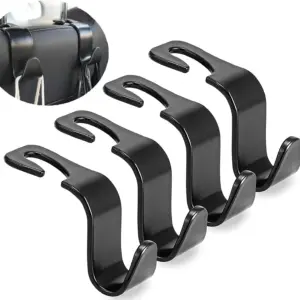
Car Headrest Hooks (4-Pack) – Clip-On Easy Installation
Price range: $2.49 through $4.99 Select options This product has multiple variants. The options may be chosen on the product page -
Car accessories
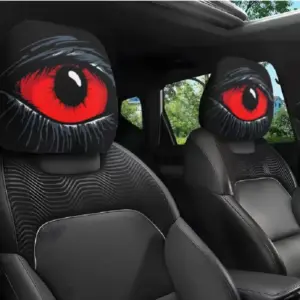
Halloween Car Headrest Covers (2-Pack) – Horror Face Print, Universal
$12.99 Select options This product has multiple variants. The options may be chosen on the product page
Frequently asked questions
Do headrest hooks fit every car?
Almost, but not quite. They clamp to the two vertical posts under the headrest, so any seat with exposed posts takes one. Cars with integrated headrests — the seat and headrest moulded as a single piece, common in some sports seats and a growing number of rear benches — have nothing to clamp to.
Will the hook damage a leather seat?
Not if the contact edge is smooth and the posts are clean. Both risks are removed by a felt pad, which costs nothing and is the answer if you are at all precious about the interior.
How much weight can I actually hang on one?
Stay meaningfully below the printed rating rather than at it, because the rating is a static number and a car is not a static environment. Half the rated figure is a sensible working load, and it still comfortably covers a shopping bag or a handbag.
More small fixes for the space you sit in twice a day are in our guide to car accessories that fix commute annoyances, and the full range is in the car accessories collection. If you are buying for someone else, practical gadget gifts under $50 covers the same ground for presents.