

A dog sling carrier solves a specific problem: a small dog who cannot manage the whole walk, a vet waiting room, a transit trip, a city where carrying is easier than weaving a lead through a crowd. The listings all say hands-free and stylish. Almost none of them answer the two questions that actually matter, which are how long a dog should be in one and how you know it fits.
How long is too long
This is the question the market is quietest about, so here is a straight answer: think in terms of a trip, not a day. A sling holds a dog in one position with limited ability to shift weight, stretch a spine or change the angle of a joint. A twenty-minute errand is unremarkable. Several hours without a break is not, whatever the padding.
The practical rule is to let the dog out to stand, stretch and relieve itself at least as often as you would on a normal walk. If your dog is repositioning constantly, panting without heat, or trying to climb out, the session is over — those are the same signals you would read anywhere else.
Puppies, seniors and dogs with joint or back conditions want shorter still, and a vet’s view first if there is a diagnosis involved.
Sizing is a weight limit and a body length
Most slings are built for dogs between roughly 5 and 15 lbs, with some rated to 18. That range covers the obvious breeds — chihuahuas, yorkies, pomeranians, small terriers — and stops well short of anything mid-sized.
Weight is the stated limit, but body length is the one that determines comfort. A dog whose body is longer than the sling pouch ends up with the spine curved and the hind legs unsupported, which is the position that produces the constant repositioning above. Measure from chest to base of tail and compare it against the pouch, not just the scale reading.
- Check for an internal safety clip that attaches to a harness, not a collar. A clip to a collar turns a fall into a neck injury.
- Look for a closure that holds the opening narrow enough that a dog cannot get a shoulder out.
- A wide, padded shoulder strap matters more than it sounds — a 12 lb dog on a thin strap is uncomfortable within a block.
- Machine washable is not a luxury on something a dog sits in.
Getting a dog used to it
A sling is a strange sensation for an animal that has never been off the ground without being held. Dropping a dog into one on the morning of a vet trip is how you find out it hates slings, at the worst possible moment.
Introduce it flat first: put the sling on the floor, let the dog stand in it, feed a treat, take it away. Then lift for a few seconds while standing still. Then walk a lap of the room. Most dogs are fine within a handful of short sessions, and the ones who are not have told you something useful before you were relying on it.
One practical detail people discover late: put the sling on before you pick the dog up, not after. Trying to get a strap over your head while holding a wriggling animal is how dogs get dropped.
Where a sling is the wrong choice
In a car, always. A sling is not a restraint and does not belong in a vehicle in place of a crate or a crash-tested harness. On a bike, likewise.
It is also wrong for a dog who is perfectly capable of walking and simply prefers not to. Carrying a fit dog that could be exercising is a fast route to a dog who will not walk at all.
Washing, and the hygiene nobody mentions
A sling collects hair, dander and whatever your dog walked through before you picked it up, and it sits against your body. Check that it is machine washable before buying, because a sling that is spot-clean only is a sling that stops being pleasant within a month.
The detail worth checking is whether the internal safety clip and any stiffening panel come out. A clip left in the machine snags the fabric and beats up the drum; a panel that cannot be removed means the sling takes two days to dry.
For dogs that get carried after walks rather than instead of them, a washable liner or a small towel in the base is the low-effort answer, because it takes the dirt and washes separately.
Shop this guide
Picks from this category, priced in USD.
-
Pet accessories
Crossbody Pet Sling Carrier – Hands-Free Travel Tote for Small
Price range: $19.99 through $24.99 Select options This product has multiple variants. The options may be chosen on the product page -
Pet accessories
Silicone Pet Grooming Glove – Bath Brush and De-Shedding
$7.99 Select options This product has multiple variants. The options may be chosen on the product page -
Pet accessories
Dog Pooper Scooper with Built-In Bag Dispenser – One-Handed
Price range: $9.99 through $25.99 Select options This product has multiple variants. The options may be chosen on the product page
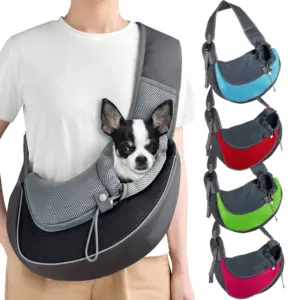


Frequently asked questions
Is a sling carrier safe for a small dog?
Yes, within the weight rating, with the internal clip attached to a harness, and for reasonable stretches rather than whole days. The design is sound; the failures come from overloading, clipping to a collar, or leaving a dog in one far too long.
Can a dog suffocate in a sling?
It is unlikely in a well-designed sling with an open top, but it is the reason to avoid fully enclosed pouches and to keep the dog’s head clear of the fabric. Airflow is the thing to check before you check the styling.
Can you fly with one?
Airlines have their own rules and most require an approved carrier that fits under the seat, which a soft sling generally is not. Check with the airline first — this is not a decision to make at the gate.
For the rest of what makes travelling with an animal easier, see pet gadgets that make pet life easier and carry-on travel gadgets that earn their space, or browse the pet gadgets collection.